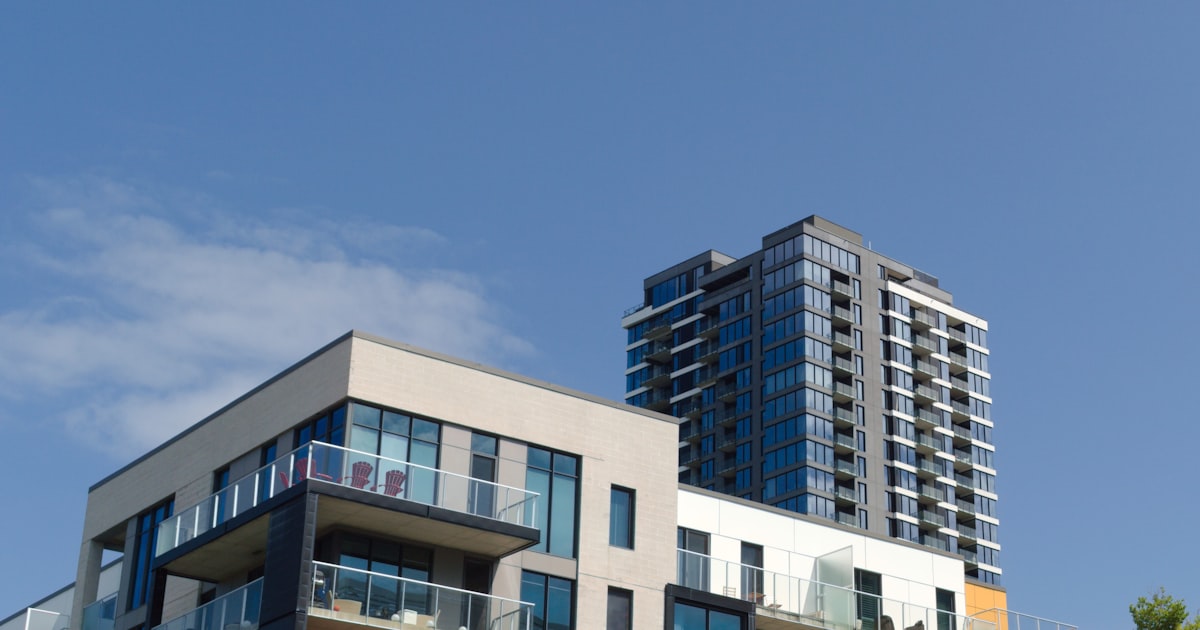
How HO-6 Differs From Standard Homeowners Insurance
An HO-6 policy — the standardized form name for condominium unit owners insurance — sits in a fundamentally different position than an HO-3 homeowners policy. With an HO-3, you insure the entire structure, the lot, and everything inside. With an HO-6, you insure a defined cube of airspace and whatever your association master policy excludes from common-area coverage.
The national average HO-6 premium runs **$400 to $800 per year**, roughly one-fifth to one-quarter of the equivalent HO-3. But that range masks enormous variation. A studio condo in Lincoln, Nebraska might run $250/yr. A waterfront unit in Miami Beach can exceed $4,500/yr — driven entirely by hurricane wind, sub-limit endorsements, and the condition of the building's master policy.
The key difference in coverage philosophy: **HO-6 follows the bylaws of your association**, which dictate where the master policy stops and your unit-owner responsibility begins. The exact same physical condo in the same building can require very different HO-6 coverage depending on whether the master policy is "bare walls," "single entity," or "all-in." Reading your declaration of condominium and master policy summary before binding is non-negotiable.
HO-6 also typically excludes earth movement, flood, and (in many cases) wind in coastal zones — the same exclusions found in HO-3 policies. In Florida (state average $7,900/yr for HO-3), HO-6 hurricane wind coverage often requires a separate endorsement or wind-only policy. In California (state average $2,100/yr for HO-3), earthquake is excluded by default and must be purchased through the California Earthquake Authority or a private carrier.
Master Policy vs Your HO-6 Policy: Where the Line Sits
Every condominium has a master policy carried by the homeowners association (HOA). Three structural variants exist, and the difference determines what your HO-6 needs to cover.
**Bare Walls (also called Original Specifications):** The master policy covers the building structure, exterior walls, roof, and common areas only — up to and including the unfinished surface of the interior walls, floors, and ceilings. **Everything inside is yours to insure**: drywall, paint, flooring, cabinetry, countertops, fixtures, appliances, and any improvements made by prior owners. This is the most common arrangement in older buildings and condo conversions. Your HO-6 dwelling coverage (Coverage A) should typically be 20-30% of the unit's market value.
**Single Entity (also called Original Specifications + Standard Fixtures):** The master policy covers the building plus standard interior fixtures as installed by the developer — original cabinetry, original appliances, original flooring. Any **upgrades or improvements** made by current or prior owners (granite counters replacing laminate, hardwood replacing carpet) are your responsibility. Coverage A on your HO-6 should target the cost of those upgrades — typically 10-20% of unit value.
**All-In (also called All-Inclusive):** The master policy covers everything within the unit including improvements. Your HO-6 only needs minimal Coverage A — often just $5,000-$25,000 to handle gaps and a deductible buffer. This is most common in newer luxury developments.
**How to find out which you have:** Request the Insurance Disclosure Summary from your HOA management. Florida, California, and most states with condominium statutes require the association to provide this within 30 days of request. The form will identify the master policy carrier, deductible, and the type of coverage.
The single biggest mistake condo owners make: assuming "bare walls" and over-insuring, or assuming "all-in" and under-insuring. Either creates wasted premium or catastrophic coverage gaps.
Walls-In vs Studs-Out: The Definitions That Matter
The terms "walls-in" and "studs-out" are insurance industry shorthand for where physical coverage begins and ends. They do not perfectly map to bare-walls vs all-in master policies — they describe the geometry of the coverage rather than the policy form.
**Walls-In (also called Drywall-In):** Coverage starts at the unfinished surface of the drywall on interior-facing walls and extends inward. This includes paint, wallpaper, flooring above the subfloor, ceiling finishes, cabinetry, and built-ins.
**Studs-Out (also called Bare-Walls-Plus):** Coverage starts at the wall studs and extends inward. This includes drywall, insulation, and everything within the unit. Studs-out policies generally require 30-40% more Coverage A than walls-in policies because the dollar value of the drywall, insulation, and rough-ins adds up.
**Practical example:** A 1,400 sq ft Texas condo (Texas average HO-3 $4,800/yr; HO-6 typically $700-$1,100/yr). With walls-in coverage, Coverage A might be $40,000-$60,000 (covering finishes, flooring, cabinetry). With studs-out, Coverage A might be $75,000-$100,000.
When you read the master policy summary, look for the phrase "as originally constructed" or "betterments and improvements excluded." That language indicates walls-in/bare-walls. Phrases like "all real property within the unit" indicate all-in coverage.
**Loss settlement basis** matters too. Replacement cost coverage (RCV) pays to rebuild without depreciation. Actual cash value (ACV) deducts depreciation. Always opt for replacement cost on the dwelling portion — the cost differential is small (5-10% of premium) and the gap at claim time is substantial.
Loss Assessment Coverage: The Most Misunderstood Coverage in HO-6
Loss assessment is unique to condo and HOA-governed properties and arguably the most important coverage in an HO-6 policy. Here is how it works.
When a covered loss happens to common property — say, a fire in the lobby, a slip-and-fall liability claim by a visitor, or hurricane damage to the roof — the master policy responds. But the master policy has a deductible, often **$25,000-$250,000**, and may have coverage limits that are exhausted by a major loss. Whatever the master policy doesn't pay gets divided among unit owners as a special assessment, billed by the HOA based on each unit's percentage ownership.
Loss assessment coverage on your HO-6 reimburses you for that assessment, up to the policy sub-limit. Standard HO-6 policies include **$1,000 of loss assessment by default** — a number that hasn't been updated meaningfully in decades and is dramatically inadequate for any real catastrophe. Increase it to **$50,000 minimum, $100,000 ideally**, especially in high-risk geographies. The premium add-on is typically $20-$60 per year for $50,000 in coverage.
**Florida loss assessment example:** A 200-unit Miami building takes hurricane damage. Master policy pays $4M with a $500,000 wind deductible. Each owner's pro-rata share of the deductible is $2,500. Owners with $1,000 loss assessment coverage pay $1,500 out of pocket. Owners with $50,000 coverage pay nothing. This scenario plays out routinely after every Florida hurricane.
**Master policy deductible coverage** is a related but distinct sub-limit on some policies. It pays your share of the master policy deductible without requiring an actual special assessment — useful when the HOA absorbs the deductible into reserves rather than billing it out.
**Liability assessments** are also covered. If the HOA is sued and a judgment exceeds the master liability limits, owners may be assessed for the shortfall. Loss assessment coverage applies to this scenario as well.
State condominium laws vary on assessment caps. Florida limits routine assessments but allows unlimited special assessments after a casualty loss. California permits a similar structure under Davis-Stirling. Florida's recent Surfside-driven legislation (SB 4-D) requires structural integrity reserves, which increases dues but reduces the assessment risk. Always read your governing documents.
Personal Property and Liability: The Standard Coverages
Beyond dwelling and loss assessment, HO-6 policies include the same core coverages as a standard homeowners policy, just sized smaller.
**Coverage C — Personal Property:** Furniture, electronics, clothing, kitchenware, and personal items inside the unit. Default limits range from $20,000-$100,000 depending on the carrier's package. Two settlement bases: actual cash value (depreciated) or replacement cost (no depreciation, costs 10-15% more in premium). Always choose replacement cost.
**Sub-limits to watch:** Most policies cap jewelry at $1,500-$2,500, firearms at $2,500, electronics at $2,000-$5,000, business property at $2,500, and cash at $200. For high-value items, schedule them individually with appraisals — scheduled items typically have no deductible, no sub-limit, and broader covered perils including mysterious disappearance.
**Coverage D — Loss of Use:** Pays for hotel, restaurant, and added living costs if your unit becomes uninhabitable. Typically 20-40% of Coverage A or a fixed dollar amount. Critical in high-rent markets — verify the daily rate is realistic for your zip code.
**Coverage E — Personal Liability:** Default $100,000; increase to $300,000-$500,000 minimum. Costs an additional $10-$30/yr per $100K. Covers bodily injury and property damage you cause off- or on-premises, defense costs, and personal injury (defamation, slander) on broader policies. Pair with an **umbrella policy** ($150-$400/yr for $1M-$2M) for true catastrophic protection.
**Coverage F — Medical Payments:** $1,000-$5,000 per person, no-fault medical coverage for guests injured in your unit. Cheap and useful for resolving small claims without litigation.
**Water backup and sewer overflow** is excluded by default. Add $5,000-$25,000 of coverage for $30-$80/yr — particularly important in older buildings or ground-floor units.
**Identity theft** restoration is included for free or near-free on most modern HO-6 policies. Worth confirming.
What Drives HO-6 Costs: Location, Building, and Deductibles
Three categories of variables drive HO-6 pricing.
**Location and catastrophe exposure.** HO-6 in low-risk states (Hawaii, Vermont, Idaho) routinely runs $200-$500/yr. In hurricane-exposed Florida, rates climb to $1,200-$4,500/yr depending on the wind tier. Texas Gulf Coast units and Louisiana coastal condos see similar pricing. California earthquake adds $300-$1,500/yr if purchased through CEA. Hawaii ($605/yr HO-3 average) sees relatively cheap HO-6 except in hurricane and lava zones.
**Building characteristics.** Newer construction (post-2000) priced 15-30% lower than 1970s-1980s buildings. Reinforced concrete construction priced 20-40% lower than wood-frame. Buildings with sprinkler systems throughout, central monitored fire alarm, and modern wiring see meaningful credits. Conversely, buildings with prior loss history, deferred maintenance, or insufficient master policy coverage are surcharged or refused outright by some carriers.
**Master policy quality.** Several carriers (notably Chubb and Cincinnati) underwrite the unit owner based on the master policy's deductible, limits, and carrier rating. A master policy with a $250,000 wind deductible will produce higher HO-6 premiums than one with a $25,000 deductible, because the loss-assessment exposure is materially larger.
**Deductible.** Standard $500-$1,000 deductibles are typical. Moving to $2,500-$5,000 saves 10-25%. Hurricane and named storm deductibles are usually a percentage (2%-5% of Coverage A) rather than a flat dollar amount.
**Credit-based insurance score.** Allowed in most states (banned in CA, MA, MD, HI). Strong credit reduces premium 15-30%.
**Claims history.** Any prior water damage, theft, or liability claim on your CLUE report increases premiums for 5-7 years.
Top Condo Insurance Carriers in 2026
The HO-6 market is more fragmented than HO-3, with several specialists alongside the national carriers.
**State Farm** is the largest writer of HO-6 nationally and offers competitive pricing in most states. Particularly strong in suburban and mid-sized urban markets. Bundling with auto saves an additional 15-20%.
**Allstate** writes aggressively in the suburbs and offers a robust loss assessment endorsement up to $50,000 standard. Good claims service ratings in J.D. Power studies.
**Travelers** is one of the better national carriers for high-rise urban condos. Their Quantum 2.0 product includes water backup and identity theft as standard.
**Liberty Mutual** is competitive on bundled HO-6 + auto and offers a worthwhile new condo discount.
**USAA** (military and family members) consistently has the highest customer satisfaction in HO-6 and competitive pricing. Loss assessment up to $100,000 included on standard policies.
**Chubb Masterpiece** is the gold standard for high-value condos ($1M+ unit value), particularly in Manhattan, Miami, San Francisco, and Boston. Extended replacement, agreed value, broad worldwide personal property coverage, and concierge claims handling. Premiums are 20-40% higher but the coverage is genuinely broader.
**Florida-specific:** Citizens Property Insurance (the state-run insurer of last resort), Universal Property, Heritage, Slide, and HomeOwners Choice are the volume players. The Florida HO-6 market remains stressed but stabilizing post-2024 reforms.
**California-specific:** CSAA, Mercury, Stillwater, and Auto Club of Southern California write meaningful HO-6 volume. Wildfire and earthquake remain separate concerns.
For shopping, use independent agents with access to multiple carriers, get at least 4-5 quotes, and **always pull the master policy summary first** — without it, no quote is meaningful. The NAIC consumer hotline, your state DOI complaint database, and the CLUE report (free annually from LexisNexis) are the authoritative resources.